I Miss Seiko’s Weird Pyramid Clock, My First Positive Experience With Talking Electronics

I Miss Seiko’s Weird Pyramid Clock, My First Positive Experience With Talking Electronics
Image for article titled I Miss Seiko's Weird Pyramid Clock, My First Positive Experience With Talking Electronics

Smart assistants like Siri, Alexa, and Google Assistant are always ready to respond to our beck and call, but talking electronics, particularly those with convincing human voices, are a fairly recent innovation. The earliest talking devices sounded like something straight out of nightmarish science fiction, but that didn’t stop me from being fascinated by a peculiar talking pyramid from the ‘80s whose sole purpose was to save you from having to read a clock.

As a child of the ‘80s, my earliest experiences with electronics that could talk came from movies and video games. The robots in Star Wars, like C3P-O and R2-D2, seemed innocent enough, but that was because their voices were either provided by a human performer, or a bunch of bleeps and bloops edited together in a way that made the robots seem friendly and approachable. By comparison, truly artificial voices—those generated by a computer—deeply creeped me out, and as a young boy I can remember deliberately avoiding going any where near arcades because of a game called Berzerk which featured robots yelling menacing phrases like ”Get the humanoid!” in unsettling synthesized voices.

I came to associate the cold, emotionless delivery of the earliest talking electronics with evil robots and computers whose only goal was to wipe out humanity, and it led to an incident in the early ‘80s where my uncle was showing off his new car and encouraged me to climb into the driver’s seat. Little did I know that it was one of the first vehicles that could talk, with warnings about lights being left on and seatbelts not buckled, and as soon as it started speaking to me I jumped out of the car as fast as I could and bolted into the house where I knew a car couldn’t reach me.

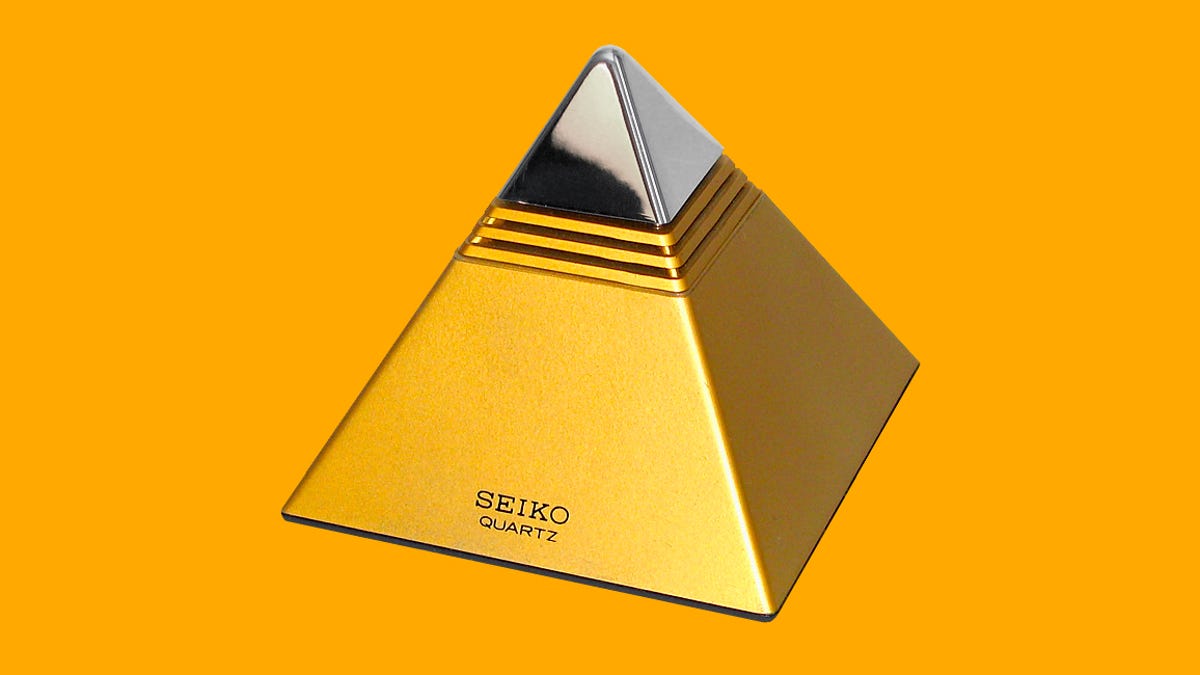
It was an irrational fear, but as far as my young mind was concerned, nothing good could come from a device that could talk. That is, until I was introduced to a weird pyramid-shaped alarm clock that Seiko released in 1984.

Unlike most grandparents who tend to shy away from the latest and greatest electronic devices and pine for ‘simpler times’, my grandmother was genuinely fascinated with the progress of technology, even if she didn’t understand it and her mastery of modern electronics ended somewhere near using the TV remote to “watch Comcast.” Having moved from Poland to the US at a young age, she maintained her fascination with the world around her and a passion for learning throughout her entire life, even though she never had the opportunity for higher learning. As my interest in electronics grew, she would always respond with a genuinely interested and impressed, “wow, those computers!” whenever I told her about the latest and greatest tech.

It wasn’t uncommon for my grandmother to receive novelty gadgets for gifts as a result, and one of those was a bedside clock that absolutely didn’t look the part. Instead of releasing

Read More

Samsung Electronics wants to dominate cutting-edge chipmaking

Samsung Electronics wants to dominate cutting-edge chipmaking

SAMSUNG ELECTRONICS (SE) is a behemoth. The South Korean tech company is the crown jewel of the mighty Samsung chaebol, as the country’s conglomerates are known. It makes more smartphones than any other company in the world, as well as home-entertainment systems and appliances. It dominates the manufacturing of memory chips, which are used to store data on electronic devices and whose price has been pushed up by the global semiconductor shortage. SE’s annual revenues of $200bn are not much lower than those of Apple, the most valuable firm in history, and it is sitting on a cash pile of $100bn.

Listen to this story

Enjoy more audio and podcasts on iOS or Android.

Now both SE and its parent group, whose name means “three stars”, are entering a critical new chapter. In August Lee Jae-yong, the scion of the family which founded Samsung in 1938, was released from prison, where he spent two stints after a conviction for his involvement in a bribery scandal. He is finally taking full control of the empire from his late father, Lee Kun-hee, who died last year. Succession was complicated first by the elder Lee’s six-year coma, then by his son’s bribery conviction, linked to SE’s efforts to win the government’s backing for a merger of two Samsung subsidiaries that would cement his control.

Free at last, Mr Lee has grand plans for the company, which he wants to become as dominant in cutting-edge logic chips, used for processing information, as it already is in memory and smartphones. That will pit SE head-to-head with chipmaking powerhouses such as TSMC of Taiwan and America’s Intel, and thrust it into a fierce global contest over one of the world’s most strategic industries.

On October 7th SE confirmed it will manufacture some of the world’s most advanced logic microprocessors, based on its novel “gate-all-around” architecture with transistors measuring three nanometres (billionths of a metre), in 2022. It also surprised analysts by announcing a plan to mass-produce two-nanometre chips from 2025. It is forecast to invest an eye-watering $37bn or so in capital expenditure across its businesses this year. And it is winning new customers, such as Nvidia, an American chip designer, and Tesla, an electric-car maker.

The outcome of Mr Lee’s gamble will have profound consequences—and not just for Samsung. It matters to South Korea, whose president justified Mr Lee’s parole as being in the national interest, given the chaebol’s importance to the economy. And it will influence the global semiconductor industry, the critical nature of which has been underscored by the worldwide chip shortage. To ensure success, the man whom acquaintances describe as shy, decent and astute must also summon a degree of ruthlessness.

SE is a complex corporate creature with a strategic challenge and underwhelming stockmarket performance. It is best understood as divided into two main businesses. The first makes “sets”: smartphones, televisions and household

Read More

AI can resolve pressing global issues, says Samsung Electronics’ vice chairman

AI can resolve pressing global issues, says Samsung Electronics’ vice chairman
Artificial intelligence may hold the key to many of the world’s pressing issues such as climate change, said Samsung Electronics Vice Chairman Kim Ki-nam on Monday.

Speaking at an annual AI forum, hosted by his company, the senior executive stressed the wide-reaching capability of AI, not just for businesses, but for the betterment of humankind.

“The advancement of AI is going beyond the electronics industry and expanding to various fields, such as basic science. We expect AI to provide solutions to social issues such as climate change and environmental pollution in the future, but there are still many challenges to tackle to make this possible,” Kim, who doubles as CEO of device solutions at Samsung Electronics, said in his opening speech of Samsung AI Forum.

In its fifth edition this year, the event kicked off Monday for a two-day run, with world-renowned AI experts participating virtually. It was livestreamed on Samsung Electronics’ YouTube channel.

The first day of the forum was hosted by Samsung’s R&D hub dedicated to cutting-edge future technologies, the Samsung Advanced Institute of Technology.

The second day will be hosted by the company’s R&D hub dedicated to consumer electronics, IT and the mobile communications division.

The company also announced this year’s winners of the Samsung AI researcher of the year award on the first day of the forum.

The awards were launched last year to recognize rising AI researchers globally.

This year’s awards went to Georgia Tech professor Diyi Yang, MIT professor Jacob Andreas, Georgia Tech professor Judy Hoffman, MIT professor Phillip Isola and Oxford University professor Yarin Gal.

“I’ll put more effort into further developing the current AI system to realize AI that is close to natural intelligence,” said Isola.

Monday also marked the 52nd anniversary of Samsung Electronics’ foundation.

Kim, in his address to employees, called on the need to prepare for the changes the future is to bring to the society.

“It is time to find a new growth engine in the super-intelligent society that will develop over the next 10 years and ask ourselves whether we will be able to stand as the most highly rated century-old company,” he said.

Kim added, “The Big Bang will arrive, where new business models and products will be rapidly evolving in all sectors of daily life,” and that they must prepare by switching to a management system that can respond preemptively for such changes.

By Hong Yoo ([email protected])


http://www.koreaherald.com/view.php?ud=20211101000845…

Read More

Don’t trash that old phone: How to get rid of unwanted electronics

Don’t trash that old phone: How to get rid of unwanted electronics

ST. LOUIS (KTVI) — If you have a growing pile of electronics in your home, it’s common to want to throw them in the trash. But that’s the last thing you should do.

E-waste contains lots of hazardous elements that can harm humans and animals, according to Scott Schaffer, chief information security officer with Blade Technologies.

Batteries are a big concern because they contain many different chemicals and can catch fire under certain conditions.

According to the Environmental Protection Agency, electronics are also made of valuable materials that “require energy to mine and manufacture.”

“Donating or recycling consumer electronics conserves our natural resources and avoids air and water pollution, as well as greenhouse gas emissions that are caused by manufacturing virgin materials,” the federal agency said.

According to the EPA, recycling 1 million laptops is equivalent to saving the amount of electricity used by more than 3,500 U.S. homes in a year. And for every 1 million recycled cell phones, 35,000 pounds of copper, 772 pounds of silver, 75 pounds of gold and 33 pounds of palladium can be recovered, said the EPA.

Those who want to recycle an electronic device should take it to a local e-waste recycler, or check to see if nearby electronics retailers are accepting old devices for recycling. The EPA also offers information on electronic donation and recycling on its website.

If you don’t want to recycle your device for any particular reason, it can also be repurposed. An old smartphone, for instance, can be used an alarm clock, security camera or remote for a smart TV. And an old tablet can be used as a digital picture frame or video call station.

Sometimes, simply upgrading the hardware or software in your computer or laptop can prolong its life and usefulness, temporarily eliminating the need for a new one.

Schaffer also suggested a number of apps that can help users find new purpose for their old devices.

  • AlfredCamera: Use for cross-platform security cameras
  • Manything: Good for repurposing iOS tablets as security cameras
  • Presence Video Security Camera: Good for using devices for security cameras
  • Alarm Clock for me: Cross-platform app to turn your device into a dedicated alarm clock
  • Apple Photos app or Google Photos app: Will let you turn your device into a dedicated smart picture frame

https://wgntv.com/news/dont-trash-that-old-phone-how-to-get-rid-of-unwanted-electronics/…

Read More

Electronics Stocks’ Oct 27 Earnings Roster: KLAC, TEL & More

Electronics Stocks’ Oct 27 Earnings Roster: KLAC, TEL & More

Electronics stocks are expected to have continued gaining from the pandemic-led work-from-home and learn-from-home trends in third-quarter 2021.

The trends, which have led to the growing proliferation of laptops, notebooks, office equipment and network peripherals, have turned out to be boons for electronics companies.

Electronics stocks’ upcoming quarterly results are expected to reflect the impacts of the growing adoption of AI, Machine Learning (ML), Augmented Reality (AR)/Virtual Reality (VR) devices, and cloud computing.

The increasing demand for data centers to ensure an efficient remote-working environment is expected to have benefited the stocks in the quarter under review.

Technical advancements in Internet infrastructure and accelerated deployment of 5G technology worldwide are also expected to have benefited industry participants in the to-be-reported quarter.

IoT-supported industrial automation and the rising demand for connected appliances are expected to have acted as tailwinds for electronic companies.

The increasing use of electronic components in smart cars and autonomous vehicles is likely to have benefited electronics companies in the quarter under review.

Solid demand in the consumer sector for connected appliances such as smart TVs, high-end smartphones, and AI-backed smart speakers is anticipated to have been a tailwind.

However, uncertainties related to the ongoing pandemic are likely to have been concerning for the industry participants in the quarter under discussion.

Sneak Peek on a Few Upcoming Releases

Let’s see how the following electronics stocks are poised ahead of their quarterly results, which are slated to be reported on Oct 27.

KLA Corporation’s KLAC first-quarter fiscal 2022 results are expected to reflect gains from a solid momentum in wafer fabrication equipment. Strength in optical pattern wafer inspection is anticipated to have persistently driven the company’s semiconductor process control segment in the quarter under review.

Growing investments in foundry, logic and memory are anticipated to have contributed well to the semiconductor process control systems business in the quarter under discussion. Also, the impacts of increasing investments in the advanced packaging market for boosting the adoption of the latest technologies are anticipated to get reflected in the upcoming quarterly results. (Read more: KLA Corp to Report Q1 Earnings: What’s in Store?)

Our proven model conclusively predicts an earnings beat for KLA Corp this time around. The combination of a positive Earnings ESP and a Zacks Rank #1 (Strong Buy), 2 (Buy) or 3 (Hold) increases the chances of an earnings beat. You can uncover the best stocks to buy or sell before they’re reported with our Earnings ESP Filter.

Notably, KLA Corp has an Earnings ESP of +0.41% and a Zacks Rank #3.

The Zacks Consensus Estimate for the company’s fiscal first-quarter earnings has been unchanged at $4.45 per share over the past 30 days.

KLA Corporation Price and EPS Surprise

KLA Corporation Price and EPS Surprise

KLA Corporation Price and EPS Surprise

KLA Corporation price-eps-surprise | KLA Corporation Quote

TE Connectivity’s TEL fourth-quarter fiscal 2021 results are anticipated to reflect benefits from its solid execution of strategies, especially cost-reduction and footprint consolidation initiatives. The growing momentum across the factory-automation and renewable

Read More

Carbon nanotubes could help electronics withstand outer space’s harsh conditions

Carbon nanotubes could help electronics withstand outer space’s harsh conditions
Carbon nanotubes could help electronics withstand outer space's harsh conditions
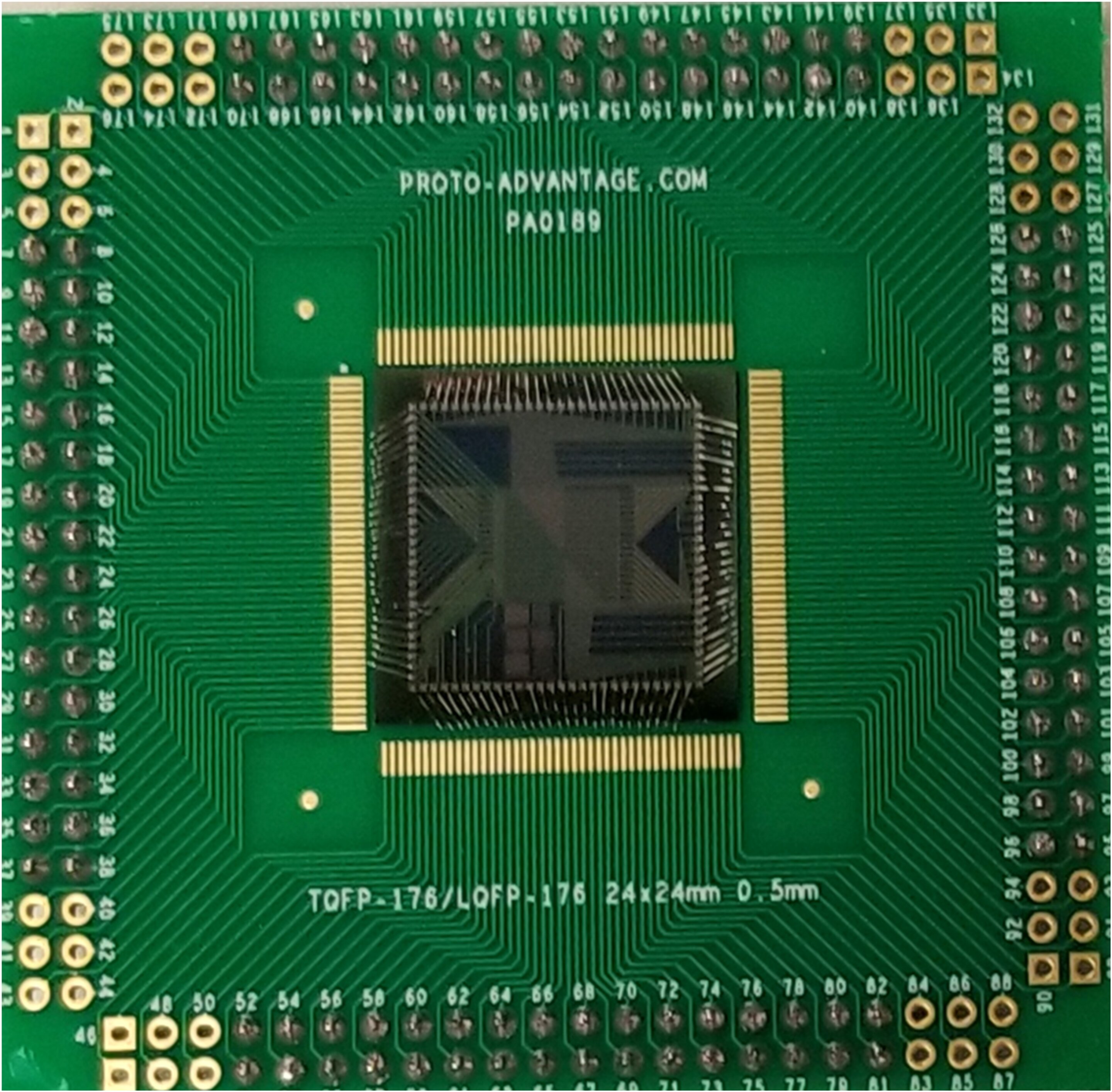
A memory chip was made of transistors with carbon nanotubes that maintained their electrical properties and memory after being bombarded by high amounts of radiation. Credit: Adapted from ACS Nano 2021, DOI: 10.1021/acsnano.1c04194

Space missions, such as NASA’s Orion that will take astronauts to Mars, are pushing the limits of human exploration. But during their transit, spacecrafts encounter a continuous stream of damaging cosmic radiation, which can harm or even destroy onboard electronics. To extend future missions, researchers reporting in ACS Nano show that transistors and circuits with carbon nanotubes can be configured to maintain their electrical properties and memory after being bombarded by high amounts of radiation.

The lifetime and distance of deep space missions are currently limited by the energy efficiency and robustness of the technology driving them. For example, harsh radiation in space can damage electronics and cause data glitches, or even make computers break down completely. One possibility is to include carbon nanotubes in widely used electronic components, such as field-effect transistors. These single-atom-thick tubes are expected to make transistors more energy efficient compared to more run-of-the-mill silicon-based versions. In principle, the ultra-small size of the nanotubes should also help reduce the effects that radiation would have when striking memory chips containing these materials. However, the radiation tolerance for carbon nanotube field-effect transistors has not been widely studied. So, Pritpal Kanhaiya, Max Shulaker and colleagues wanted to see if they could engineer this type of field-effect transistor to withstand high levels of radiation, and build memory chips based on these transistors.

To do this, the researchers deposited carbon nanotubes on a silicon wafer as the semiconducting layer in field-effect transistors. Then, they tested different transistor configurations with various levels of shielding, consisting of thin layers of hafnium oxide and titanium and platinum metal, around the semiconducting layer. The team found that placing shields both above and below the carbon nanotubes protected the transistor’s electrical properties against incoming radiation up to 10 Mrad—a level much higher than most silicon-based radiation-tolerant electronics can handle. When a shield was only placed beneath the carbon nanotubes, they were protected up to 2 Mrad, which is comparable to commercial silicon-based radiation-tolerant electronics. Finally, to achieve a balance between fabrication simplicity and radiation robustness, the team built static random-access memory (SRAM) chips with the bottom shield version of the field-effect transistors. Just as with experiments performed on the transistors, these memory chips had a similar X-ray radiation threshold as silicon-based SRAM devices.

These results indicate that carbon nanotube field-effect transistors, especially double-shielded ones, could be a promising addition to next-generation electronics for space exploration, the researchers say.


Radiation-immune and repairable chips to fabricate durable electronics


More information:
Carbon Nanotubes for Radiation-Tolerant Electronics, ACS Nano (2021). DOI: 10.1021/acsnano.1c04194
Provided by
American Chemical Society


Citation:
Carbon nanotubes could help electronics withstand outer space’s harsh conditions (2021, October 27)
retrieved 29 October 2021
from https://phys.org/news/2021-10-carbon-nanotubes-electronics-outer-space.html

This document is subject to copyright. Apart from any fair dealing for the purpose of private study or research,

Read More