Developing 3-D electronics with pre-distorted pattern generation and thermoforming

Developing 3-D electronics with pre-distorted pattern generation and thermoforming
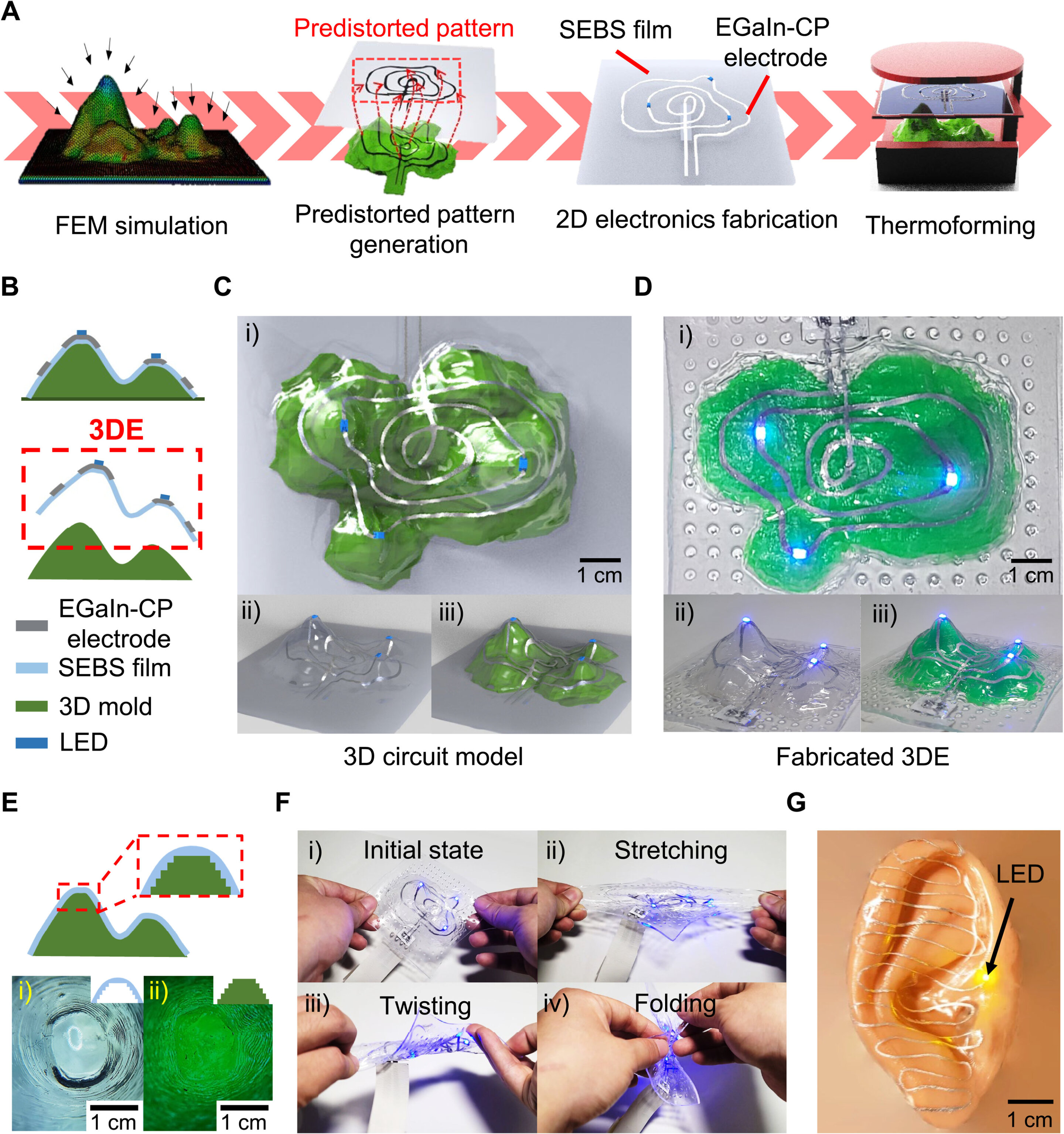
Overview of the fabrication method of 3DE based on predistorted pattern generation and thermoforming process (referred to as PGT3DE) featuring high customizability, conformability, and stretchability. (A) Basic mechanism of the PGT3DE. 3DE can be fabricated using thermoforming simulation and the predistorted pattern generation method. (B) Schematic cross-sectional illustration of fabricated 3DE based on PGT3DE. (C and D) Designed 3D circuit model (C) and fabricated 3DE (D) [(i) top view and (ii and iii) bird’s eye view without the 3D mold (ii) and with the 3D mold (iii)]. (E) 3D conformal property of the thermoformed SEBS film with a microscope image of thermoformed SEBS film (i) and 3D mold (ii). (F) Electrical stability under various deformations; the 3DE is robust under stretching (ii), twisting (iii), and folding (iv) deformations without electrical disconnection. (G) Ear-shaped 3DE. The LEDs in the 3DE are well lit because of the successful electrical interconnection. Photo credit: Jungrak Choi, Korea Advanced Institute of Science and Technology (KAIST). Credit: Science Advances, 10.1126/sciadv.abj0694

Three-dimensional electronics (3-DE) is attracting much interest due to the increasing demands for seamless integration on curved surfaces. Nevertheless, it is challenging to develop 3-DE with high customizable conformity and stretchability. In a new report now published in Science Advances, Jungrak Choi and a research team in mechanical engineering, materials science and science and technology in South Korea presented a method to form three-dimensional electronics based on predistorted pattern generation and thermoforming. Using thermoplastic elastomer and liquid-metal-based conductive electrodes, they accomplished high thermoformability and stretchability during device fabrication and function. The new technology can facilitate a wide range of functionalities in wearable technologies.

Developing 3-DE

Three-dimensional electronics have high customizability, 3D conformability and stretchability to form state-of-the-art stretchable electronics in response to the increasing demands to form curvilinear surfaces for wearable sensors. The process to directly develop 3-DE with high customizability, 3D conformability and stretchability on any complicated surface are in high demand. Among the many development methods, thermoforming is a manufacturing technique that uses thermoplastic deformation of a plastic film onto a 3D shaped mold with the advantages of low fabrication cost, large area scalability and quick prototyping. In this work, Choi et al. developed a method for 3-DE based on pre-distorted pattern generation and thermoforming abbreviated as PGT3DE with a thermoplastic elastomer and liquid metal-based conductive electrode. During the 3-DE fabrication process, the team applied a highly stretchable thermoplastic elastomer-based substrate such as styrene-ethylene-butylene-styrene (SEBS) and a stretchable conductive electrode such as eutectic gallium-indium-based liquid metal mixed with copper microparticles.


Electrical and mechanical stability test of the 3DE under stretching, twisting, and folding deformations. Credit: Science Advances, 10.1126/sciadv.abj0694

Experimental overview

As proof of concept, the scientists designed a 3D circuit model and lit three LEDs on the 3D surface and noted its stretchability for flexible deformations, without electrical disconnection during the process. They also developed complicated shapes including an ear-shaped 3-DE. The team followed two key steps to form 3-DE based on the pre-distorted pattern generation and thermoforming (PGT3DE)

Read More

Inside the supply chain crisis: How it took months to get electronics from China to the U.S.

Inside the supply chain crisis: How it took months to get electronics from China to the U.S.

Us citizens are getting warned to end their holiday shopping early this 12 months, as the world supply chain proceeds to falter. With a scarcity of containers, ships and electrical power making snags, CBS News determined to monitor a pair of high-performance speakers as they journeyed from the producing metropolis of Guangzhou, China, to the U.S. 

On a great working day, staff at a Guangzhou manufacturing unit build and box up 2,000 speakers — as extended as the energy is on. Philip Richardson, an American, operates the manufacturing facility and says random electrical power outages plaguing China are costing him time and income. 

“If we’re shut down for more than 15 minutes, then it generates a headache,” Richardson stated. A generator keeps the manufacturing unit managing, he reported, but noted that “Electrical energy from a generator for our application charges me at minimum 4 periods additional for every hour.” 

The electricity issues appear as China attempts to reduce carbon emissions — but cuts in coal creation have led to history price ranges. Utility organizations are prohibited from boosting their expenses to match that rise, and considering that they are not able to make dollars, they prevent making electrical energy. 

You will find a distinctive issue by the time Richardson’s speakers leave the manufacturing facility and head to a Chinese port: manpower. Dock employees invest 3 months in quarantine for every single two months on the work. 

“They can be exposed to the COVID virus coming in by means of the supply chain. So that is what China is fearful about,” mentioned Ker Gibbs, the president of the American Chamber of Commerce in Shanghai. 

Following a two-7 days journey across the Pacific, most container ships finish up anchored off the coast of Southern California, in which they sit for even for a longer time. When the ships last but not least unload, the containers are stacked as far as the eye can see, waiting a number of times for vans and trains to carry them throughout the U.S. 

Months have passed by the time Richardson’s speakers arrive at Alto Audio in Middletown, New York. The new music store’s owner, Jon Haber, claims he is spending virtually five occasions as a lot for shipping and delivery. 

“Now, it prices like $25,000 and can take 90 times,” he mentioned. “It’s unbelievable!” 

Haber stated he also has to ship capacitors, very small digital factors that are significant for a further a single of his products, to China for the reason that of shortages overseas. 

“I’m sending them to China so they can make my products and solutions,” Haber said. “It is really nuts.” 

He has experienced to increase some of his prices to prevent losing income and isn’t going to expect costs to arrive again down. 

“I have been doing this 30-something yrs, I hardly ever noticed a maker raise the price tag, ‘Oh we are sorry, we really feel lousy, we are likely to deliver them back again down.’ The moment they go

Read More

With electronics on holiday wish lists, Samsung and Apple are meeting shoppers back in stores

With electronics on holiday wish lists, Samsung and Apple are meeting shoppers back in stores

Samsung is opening an working experience retailer in Frisco’s Stonebriar Centre. Target is adding extra Apple shops within its retailers by Christmas.

It is no incident that the two biggest smartphone makers of Galaxy and iPhones are chasing buyers back again to brick-and-mortar outlets.

The outlook for 5G telephones — the most up-to-date smartphone iteration — is robust this getaway time and the units top rated consumers’ electronics desire lists, according to a survey by business trade team Consumer Technological know-how Association.

In November 2019, U.S. buyers considered their smartphones ought to moderately final 4.2 yrs, and at that time, the common age of a smartphone was just about 2 a long time, according to CTA.

But there’s a thing new to purchase this calendar year. Samsung introduced its Galaxy Z Flip 3 and ZFold3 in August and Apple unveiled its new Apple iphone 13 lineup in September.

Samsung said its knowledge merchants are a reaction to purchasers heading back to the mall this holiday year. The South Korean organization has opened 4 practical experience shops so considerably, with a person in the Houston Galleria and a single each and every in major malls in Los Angeles, New York and Palo Alto. It started opening the suppliers just right before the pandemic in 2019.

At Stonebriar, the Samsung working experience retail outlet will open up on the initial stage of Fossil’s previous 3,800-sq.-foot space. Until finally that keep is ready, most likely ideal right after Xmas, the business stated it has set up a 10-foot by 20-foot momentary retailer anchored by a Ford Wagon in the mall corridor around Barnes & Noble. Galaxy foldable smartphones, tablets, smartwatches and earbuds will be on display.

Samsung declined to say regardless of whether this is the beginning of a additional in depth retail store rollout.

When Apple retailers have been all over for 20 years, Samsung has mostly bought its Galaxy telephones right on the web, or by means of major wireless carriers and vendors this kind of as Ideal Purchase and Walmart.

Target and Apple have a large overlap in customers, and now the chain will be giving Apple twice the space it had in its electronics department.

Apple retailers started out showing up in February inside of Focus on retailers, such as Allen, Hurst and Irving places. A 2nd batch of Apple outlets are opening before long in Rockwall, Arlington, Denton, North Richland Hills, Flower Mound, Frisco and Watauga.

An all-time large of 191.3 million U.S. adults strategy to buy technology as a reward this holiday season, based mostly on CTA estimates, but spending in the class will only be up .5% from a yr in the past.

A great deal of electronics were being bought last year to accommodate operating and schooling from home. But the pandemic also “gave a lot more people today time and incentive to discover the several strategies technological innovation can enhance their life,” mentioned Lesley Rohrbaugh, director of current market exploration for CTA.

Electronics are on the wish lists of 26% of shoppers, according to a study of shoppers by Prosper Insights & Analytics for the National Retail Federation.

The sector

Read More

I Miss Seiko’s Weird Pyramid Clock, My First Positive Experience With Talking Electronics

I Miss Seiko’s Weird Pyramid Clock, My First Positive Experience With Talking Electronics
Image for article titled I Miss Seiko's Weird Pyramid Clock, My First Positive Experience With Talking Electronics

Smart assistants like Siri, Alexa, and Google Assistant are always ready to respond to our beck and call, but talking electronics, particularly those with convincing human voices, are a fairly recent innovation. The earliest talking devices sounded like something straight out of nightmarish science fiction, but that didn’t stop me from being fascinated by a peculiar talking pyramid from the ‘80s whose sole purpose was to save you from having to read a clock.

As a child of the ‘80s, my earliest experiences with electronics that could talk came from movies and video games. The robots in Star Wars, like C3P-O and R2-D2, seemed innocent enough, but that was because their voices were either provided by a human performer, or a bunch of bleeps and bloops edited together in a way that made the robots seem friendly and approachable. By comparison, truly artificial voices—those generated by a computer—deeply creeped me out, and as a young boy I can remember deliberately avoiding going any where near arcades because of a game called Berzerk which featured robots yelling menacing phrases like ”Get the humanoid!” in unsettling synthesized voices.

I came to associate the cold, emotionless delivery of the earliest talking electronics with evil robots and computers whose only goal was to wipe out humanity, and it led to an incident in the early ‘80s where my uncle was showing off his new car and encouraged me to climb into the driver’s seat. Little did I know that it was one of the first vehicles that could talk, with warnings about lights being left on and seatbelts not buckled, and as soon as it started speaking to me I jumped out of the car as fast as I could and bolted into the house where I knew a car couldn’t reach me.

It was an irrational fear, but as far as my young mind was concerned, nothing good could come from a device that could talk. That is, until I was introduced to a weird pyramid-shaped alarm clock that Seiko released in 1984.

Unlike most grandparents who tend to shy away from the latest and greatest electronic devices and pine for ‘simpler times’, my grandmother was genuinely fascinated with the progress of technology, even if she didn’t understand it and her mastery of modern electronics ended somewhere near using the TV remote to “watch Comcast.” Having moved from Poland to the US at a young age, she maintained her fascination with the world around her and a passion for learning throughout her entire life, even though she never had the opportunity for higher learning. As my interest in electronics grew, she would always respond with a genuinely interested and impressed, “wow, those computers!” whenever I told her about the latest and greatest tech.

It wasn’t uncommon for my grandmother to receive novelty gadgets for gifts as a result, and one of those was a bedside clock that absolutely didn’t look the part. Instead of releasing

Read More

3 Consumer Electronic Industry Trends Shaping Our Lives

3 Consumer Electronic Industry Trends Shaping Our Lives

Opinions expressed by Entrepreneur contributors are their own.

Consumer electronics stands as one of the biggest industries that showcase technological advancements most clearly. Today, most people have devices in their homes that would have only been available to the biggest research laboratories and the ultra-wealthy in the most recent past. As technological capability continues to grow, manufacturers are in a race to roll out devices that can change the quality of life.

The past few years have been a particularly active period in the industry. First, the pace of tech advancement has increased exponentially, along with the number of companies involved in producing the devices. In addition, a variety of events have shaped the direction of innovation, shifting the focus of big and small manufacturers alike to certain areas. These trends are a big opportunity for everyone in the industry, from large-scale manufacturers to small startups and their investors. Those who can get ahead of the curve will be able to reap the benefits of meeting increasingly large and seemingly endless customer demand. That demand is estimated to cross $1.5 trillion in five years.

Health tech

This sector of the industry has been driven to prominence recently in large part by the global pandemic. Companies have worked hard to provide new devices that can be used to safeguard people from illness. Those devices have spanned the gamut, from smart face masks that provide N95-grade protection while also delivering UV sterilization and voice projection to robots that can disinfect spaces autonomously.

There has also been a trend toward telemedicine and health monitoring, with McKinsey projecting that the market will reach $250 billion soon. Many smartwatch brands have included more sensors on their products for more holistic health tracking, and AI monitoring systems for elderly people have also been deployed to automatically raise alerts when they sense any health issues, even if the affected person is unable to do so themselves.

Related: 5 Ways Technology Is Changing Ecommerce

Remote life and DIY

Nowadays, up to 71% of people are working from home, according to Pew Research. That’s an amazing increase from recent years, and the consumer electronics industry has been providing just the devices to facilitate that for all parties involved, from employees and workplace supervisors to students and schoolteachers. Ergonomically-designed furniture with controls to change the fit at any time are now commonplace, and screen technology to deliver crisp viewing experiences with minimal eye fatigue can also be seen in an increasing number of home offices.

As many people have also begun to handle most of their tasks themselves, companies have also begun to provide tools to facilitate the growing DIY trend. Several companies, including Samsung, have shown off domestic robots that can handle everything from dishwashing to laundry and potentially serving drinks. For more hands-on people, getting access to tools like battery-powered cordless airbrushes allows even novices to take on home improvement projects, and other similar items are now attainable as prices have dropped despite expanding feature

Read More

Samsung Electronics wants to dominate cutting-edge chipmaking

Samsung Electronics wants to dominate cutting-edge chipmaking

SAMSUNG ELECTRONICS (SE) is a behemoth. The South Korean tech company is the crown jewel of the mighty Samsung chaebol, as the country’s conglomerates are known. It makes more smartphones than any other company in the world, as well as home-entertainment systems and appliances. It dominates the manufacturing of memory chips, which are used to store data on electronic devices and whose price has been pushed up by the global semiconductor shortage. SE’s annual revenues of $200bn are not much lower than those of Apple, the most valuable firm in history, and it is sitting on a cash pile of $100bn.

Listen to this story

Enjoy more audio and podcasts on iOS or Android.

Now both SE and its parent group, whose name means “three stars”, are entering a critical new chapter. In August Lee Jae-yong, the scion of the family which founded Samsung in 1938, was released from prison, where he spent two stints after a conviction for his involvement in a bribery scandal. He is finally taking full control of the empire from his late father, Lee Kun-hee, who died last year. Succession was complicated first by the elder Lee’s six-year coma, then by his son’s bribery conviction, linked to SE’s efforts to win the government’s backing for a merger of two Samsung subsidiaries that would cement his control.

Free at last, Mr Lee has grand plans for the company, which he wants to become as dominant in cutting-edge logic chips, used for processing information, as it already is in memory and smartphones. That will pit SE head-to-head with chipmaking powerhouses such as TSMC of Taiwan and America’s Intel, and thrust it into a fierce global contest over one of the world’s most strategic industries.

On October 7th SE confirmed it will manufacture some of the world’s most advanced logic microprocessors, based on its novel “gate-all-around” architecture with transistors measuring three nanometres (billionths of a metre), in 2022. It also surprised analysts by announcing a plan to mass-produce two-nanometre chips from 2025. It is forecast to invest an eye-watering $37bn or so in capital expenditure across its businesses this year. And it is winning new customers, such as Nvidia, an American chip designer, and Tesla, an electric-car maker.

The outcome of Mr Lee’s gamble will have profound consequences—and not just for Samsung. It matters to South Korea, whose president justified Mr Lee’s parole as being in the national interest, given the chaebol’s importance to the economy. And it will influence the global semiconductor industry, the critical nature of which has been underscored by the worldwide chip shortage. To ensure success, the man whom acquaintances describe as shy, decent and astute must also summon a degree of ruthlessness.

SE is a complex corporate creature with a strategic challenge and underwhelming stockmarket performance. It is best understood as divided into two main businesses. The first makes “sets”: smartphones, televisions and household

Read More