


Developer jobs and programming languages: What’s hot and what’s next

Developer jobs and programming languages: What’s hot and what’s next
software-developer-special-report-coding-programming.jpg

Software development is the hottest job on the market – and business is booming.


Image: SolisImages/GETTY

The role of the software developer is as central to an organization’s success now as those right at the top. While they might not be involved in corporate decision making, developers are crucial to steering growth within the enterprise in a market in which software savviness is increasingly a marker of commercial success.

Running technology in a business has become a business in itself. As commerce goes digital and consumers spend more time working, shopping and managing their lives from home, companies are spending billions of dollars to showcase their technology and maintain a lead on competitors. As a result, software creators find themselves in enormous demand.

This ZDNet Special Feature series is both an examination of the role of developers and the work they do, as well as an exploration into the trends that are shaping the software industry, and with it, the direction of travel for businesses in the coming months and years. Our ambition is to cast a light on the value of software developers in the modern digital workplace, as well as investigate the skills, technologies and programming languages that are driving market demand.

Programming languages 

According to CompTIA’s February 2022 Tech Jobs Report, software developers are the biggest driver of tech-hiring activity within US organizations. The average salary of US tech workers in 2018 was $84,300; today, it’s closer to $120,500, with those in decision-making positions able to earn an average salary of $138,200, according to CompTIA.

Dice’s 2022 Tech Salary Report recorded a 6.9% increase in the average technologist salary between 2019 and 2021, reaching $104,566. “That’s the highest salary ever recorded by the Dice Salary Report, and a positive sign for technologists in terms of the current and potential future value of their skills and experience,” the authors noted.

SEE: The easiest programming languages to learn 

The fact that some of the best-paying jobs are in tech is a testament to the value that these professionals bring to businesses, and as such, having one or more programming languages under your belt is going to make you extremely appealing in the eyes of recruiters. Businesses are currently falling over themselves to secure the talent they need to move with the times, making software jobs a secure and lucrative employment field in an otherwise uncertain economic climate.

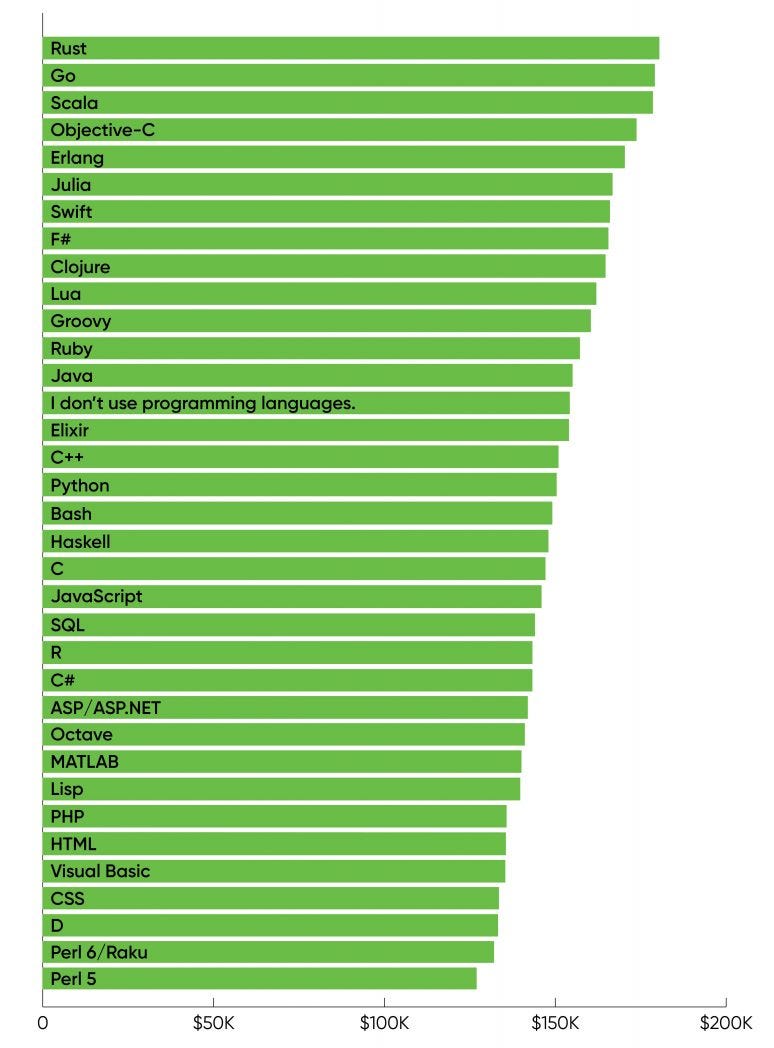
According to O’Reilly’s 2021 Data and AI Salary Survey, developers who work with niche programming languages are likely to take home higher average salaries than their more common counterparts, largely owing to the fact that they are in such short supply.
oreilly-salary-by-programming-language.jpg

Salary by programming language – O’Reilly 2021 Data/AI Salary Survey.


Image: O’Reilly

Its survey found that the most widely used and popular programming languages fell in the middle of the salary range. This included Python ($150,000), SQL ($144,000), Java ($155,000), and JavaScript ($146,000). Web languages, such as HTML, PHP, and CSS, were at the bottom of the range, at

… Read More

AWS: Here’s why we are investing in the Rust programming language

AWS: Here’s why we are investing in the Rust programming language

Cloud-computing big Amazon World-wide-web Expert services (AWS) has outlined the factors its engineers are embracing Rust, which includes that it is a additional electrical power-successful programming language.

Just 7 a long time in the past, the Rust programming language attained model 1., building it a person of the youngest languages and a person that also holds large assure for massive code bases written in C and C++. Currently, Amazon, Google, and Microsoft back the language that at first began as a individual project of Graydon Hoare in advance of starting to be a investigate challenge at Mozilla in 2010.

Rust isn’t as well-liked as Java, JavaScript or Python, but it is really grow to be a significant language for constructing techniques like the Linux kernel, Home windows, Chrome, and Android. AWS was an early supporter of Rust and is a founding member of the Rust Foundation, and has an ongoing Rust recruitment generate. 

SEE: Net developer or CTO, which tech work opportunities have the speediest growing salaries?

Rust will help developers prevent a host of memory-relevant flaws popular to C/C++, which eventually charge organizations in stability updates. The language obtained its most significant-profile aid when Microsoft exposed it was experimenting with it for Windows, chiefly to dodge memory bugs. 

But a write-up by AWS’s Rust advocate and software engineer Shane Miller and Carl Lerche, a principal engineer at AWS, highlights that Rust isn’t only about memory protection and lessening stability flaws it is really a much greener language than Python and Java. In that way, it backs up Amazon’s broader drive to make its facts facilities a lot less destructive to the atmosphere, with the enterprise aiming to have its datacenters go absolutely renewable by 2025. 

AWS companies designed on Rust incorporate Firecracker, the know-how behind its Lamba serverless system for containerized applications, Amazon Straightforward Storage Service (S3), Elastic Compute Cloud (EC2), its CloudFront written content delivery network, and Bottlerocket, a Linux-based container OS.     

Datacenters make up 1% of the world’s energy consumption, amounting to about 200 terawatt several hours of power a working day, and the programming languages made use of can also affect electrical power use. 

“It is not a shock that C and Rust are much more economical than other languages. What is stunning is the magnitude of the distinction. Broad adoption of C and Rust could reduce energy consumption of compute by 50% – even with a conservative estimate,” claims Miller, pointing to a study showing the relative electricity efficiency of languages, from C to Google’s Go, Lua, Python, Ruby and previous Fortran.   

“Rust delivers the strength effectiveness of C without the need of the risk of undefined conduct. We can slash energy use in half devoid of shedding the added benefits of memory basic safety,” states Miller. 

She points to the general performance of an app by cybersecurity organization Tenable that was earlier created in JavaScript but is now prepared in Rust. The Rust app trounces JavaScript in CPU effectiveness, chopping latency by 50

… Read More

Meet Twist: MIT’s Quantum Programming Language

Meet Twist: MIT’s Quantum Programming Language

While machine learning has been around a long time, deep learning has taken on a life of its own lately. The reason for that has mostly to do with the increasing amounts of computing power that have become widely available—along with the burgeoning quantities of data that can be easily harvested and used to train neural networks.

The amount of computing power at people’s fingertips started growing in leaps and bounds at the turn of the millennium, when graphical processing units (GPUs) began to be
harnessed for nongraphical calculations, a trend that has become increasingly pervasive over the past decade. But the computing demands of deep learning have been rising even faster. This dynamic has spurred engineers to develop electronic hardware accelerators specifically targeted to deep learning, Google’s Tensor Processing Unit (TPU) being a prime example.

Here, I will describe a very different approach to this problem—using optical processors to carry out neural-network calculations with photons instead of electrons. To understand how optics can serve here, you need to know a little bit about how computers currently carry out neural-network calculations. So bear with me as I outline what goes on under the hood.

Almost invariably, artificial neurons are constructed using special software running on digital electronic computers of some sort. That software provides a given neuron with multiple inputs and one output. The state of each neuron depends on the weighted sum of its inputs, to which a nonlinear function, called an activation function, is applied. The result, the output of this neuron, then becomes an input for various other neurons.

Reducing the energy needs of neural networks might require computing with light

For computational efficiency, these neurons are grouped into layers, with neurons connected only to neurons in adjacent layers. The benefit of arranging things that way, as opposed to allowing connections between any two neurons, is that it allows certain mathematical tricks of linear algebra to be used to speed the calculations.

While they are not the whole story, these linear-algebra calculations are the most computationally demanding part of deep learning, particularly as the size of the network grows. This is true for both training (the process of determining what weights to apply to the inputs for each neuron) and for inference (when the neural network is providing the desired results).

What are these mysterious linear-algebra calculations? They aren’t so complicated really. They involve operations on
matrices, which are just rectangular arrays of numbers—spreadsheets if you will, minus the descriptive column headers you might find in a typical Excel file.

This is great news because modern computer hardware has been very well optimized for matrix operations, which were the bread and butter of high-performance computing long before deep learning became popular. The relevant matrix calculations for deep learning boil down to a large number of multiply-and-accumulate operations, whereby pairs of numbers are multiplied together and their products are added up.

Over the years, deep learning has required an ever-growing number of these multiply-and-accumulate operations. Consider

… Read More

TIFF unveils crucial additions to programming team, details of 2022 version | Information

TIFF unveils crucial additions to programming team, details of 2022 version | Information

Toronto TIFF generic Connie Tsang

Toronto International Movie Competition (TIFF) has declared five new critical members of the programming crew and unveiled short particulars of this year’s version which is established to operate from September 8–18.

Robyn Citizen will guide the pageant programming group and has been appointed TIFF’s director of pageant programming & Cinematheque. Citizen started at TIFF in 2018 and prior to that was a movie lecturer in the departments of Asian experiments and theatre and film at University of British Columbia from 2012-17 ahead of that, Citizen was board co-chair for Breakthroughs Movie Festival and programmed for Human Rights Movie Pageant.

Andréa Picard has stepped into the whole-time function of senior curator, TIFF & TIFF Cinematheque. She has labored for TIFF given that 1999 as a member of the TIFF Cinematheque programming group and, considering that 2006, as curator of Wavelengths.

Jane Schoettle has returned to direct programming of TIFF’s Exclusive Displays part as senior global programmer. Schoettle has worked for numerous a long time as an worldwide programmer for TIFF responsible for movies from Australia, New Zealand, and Israel as very well as American unbiased cinema. She has programmed thoroughly for festivals in Miami, Aspen, and Palm Springs and for quite a few years developed TIFF Expertise Enhancement programmes Filmmaker Lab and Writers’ Studio.

Jason Ryle has joined and takes on the new job of international programmer, Indigenous cinema which will be programmed across the pageant. He is an Anishinaabe from Lake St. Martin, Manitoba, and has labored as a producer, programmer, curator, tale editor and arts expert. He was executive director of imagineNATIVE from 2010-20, overseeing all operational and inventive pursuits of the once-a-year imagineNATIVE Film + Media Arts Competition, including year-spherical initiatives, global partnerships, and particular tasks.

Kelly Boutsalis, a Mohawk journalist from the Six Nations of the Grand River reserve, joins TIFF as affiliate programmer for Canadian aspect movies, although Ravi Srinivasan rejoins TIFF in a full-time part as senior supervisor, TIFF programming and will lead to the festival’s programming of Canadian feature movies and films from Southeast Asia.

Srinivasan has worked for TIFF as a seasonal programmer because 2013. Prior to his new role he was an global programmer at Sizzling Docs and founder and govt director of the South Western Worldwide Movie Competition.

Women comprise 50% of the total programming group. Seasonal programmers returning for TIFF 2022 are: Jason Anderson, intercontinental programmer, Limited Cuts Diana Cadavid, global programmer Giovanna Fulvi, senior global programmer Nataleah Hunter-Youthful, international programmer Peter Kuplowsky, worldwide programmer, Midnight Madness Dorota Lech, international programmer and Thom Powers, direct programmer, TIFF Docs.

Comprehensive-time TIFF staff customers Steve Gravestock (competition programming) and Geoff Macnaughton (lead programmer, Primetime) spherical out this year’s team of TIFF programmers.

At time of creating, and assuming there is no late summertime surge in Covid-19 cases, TIFF’s 47th edition will see the return of TIFF’s networking and celebratory occasions return including TIFF Opening Evening Party, Field Meeting, filmmaker dinners, Industry networking activities, press and programmers activities and TIFF Tribute Awards Gala.

… Read More

Interview with Magnus Madsen about the Flix Programming Language

Interview with Magnus Madsen about the Flix Programming Language

Flix, an open-source programming language inspired by many programming languages, enables developers to write code in a functional, imperative or logic style. Flix looks like Scala, uses a type system based on Hindley-Milner and a concurrency model inspired by Go. The JVM language supports unique features such as the polymorphic effect system and Datalog constraints.

Flix programs are compiled to JVM bytecode and developers can use the Flix Visual Studio Code extension or evaluate the language by using the online playground.

The community develops the language based on a set of principles such as: no null value, private by default, no reflection, separation of pure and impure code, correctness over performance and no global state.

The following main function is considered impure as the println function has a side effect. The Flix compiler keeps track of the purity of each expression and guarantees that a pure expression doesn’t have side effects.


def main(_args: Array[String]): Int32 & Impure =
    println("Hello world!");
    0 // exit code

The Flix language supports Polymorphic Effects making it possible to distinguish between pure functional programs and programs with side effects. Functions are pure by default, or can explicitly be marked as pure:


def add(x: Int32, y: Int32): Int32 & Pure  = 
    x + y;

Functions with side effects can be marked explicitly as impure:


def main(_args: Array[String]): Int32 & Impure =
println(add(21, 21));
0 // exit code

The compiler displays an error Impure function declared as pure whenever side effects are used in an explicitly marked Pure function:


def add(x: Int32, y: Int32): Int32 & Pure  = 
    x + y;
    println("Hello")

The separation of pure and impure code allows developers to reason about pure functions as if they are mathematical functions without side effects.

Datalog, a declarative logic programming language, may be seen as a query language such as SQL, but more advanced. Flix supports Datalog as a first-class citizen making it possible to use Datalog constraints as function arguments, returned from functions and stored in data structures. Flix may be used with Datalog to express fixpoint problems such as determining the ancestors:


def getParents(): # r  = #
    ParentOf("Mother", "GrandMother").
    ParentOf("Granddaughter", "Mother").
    ParentOf("Grandson", "Mother").


def withAncestors(): # ParentOf(String, String), 
                        AncestorOf(String, String)  = #
    AncestorOf(x, y) :- ParentOf(x, y).
    AncestorOf(x, z) :- AncestorOf(x, y), AncestorOf(y, z).


def main(_args: Array[String]): Int32 & Impure =
    query getParents(), withAncestors() 
        select (x, y) from AncestorOf(x, y) |> println;
    0

This displays the following results:


[(Granddaughter, GrandMother), (Granddaughter, Mother), 
    (Grandson, GrandMother), (Grandson, Mother), (Mother, GrandMother)]

Flix provides built-in support for tuples and records as well as algebraic data types and pattern matching:


enum Shape 
    case Circle(Int32),          // circle radius
    case Square(Int32),          // side length
    case Rectangle(Int32, Int32) // height and width


def area(s: Shape): Int32 = match s 
    case Circle(r)       => 3 * (r * r)
    case Square(w)       => w * w
    case Rectangle(h, w) => h * 
… Read More

PCC adding far more in-man or woman group progress programming

PCC adding far more in-man or woman group progress programming

WINTERVILLE, N.C. (PCC) — After two several years of programming limitations and largely digital instruction owing to COVID-19, Pitt Neighborhood College is getting back to its roots with regard to impending Community Enhancement classes. 

   Like most everything due to the fact March 2020, the pandemic has adversely impacted PCC’s skill to present in-human being Local community Growth lessons. But this spring, the faculty has now scheduled particular enrichment courses that meet up with encounter-to-experience and will start registering youngsters for Take a look at Summer months Camps that element palms-on activities in a little far more than a month. 

   “We did a good job of optimizing our academic programming nearly, but there’s no substitute for the arms-on instruction PCC excels at supplying,” explained Dr. Dan Mayo, PCC Dean of General public Providers and Wonderful Arts. “We’re enthusiastic about the return of far more individual instruction in the classic format so lots of take pleasure in.” 

   For people today wanting to boost their culinary capabilities, Pitt is featuring a “Springtime Desserts” class to instruct them how to make anything from baked goods to cold/no-bake desserts and very simple pies. The initially chance to consider the class will be March 22-31. It will meet up with Tuesdays and Thursdays, from 6 p.m. to 8 p.m. A 2nd portion is set for April 19-28 and meets the exact same times of the 7 days at the very same instances. 

   PCC Community Progress Plans Coordinator Lisa Webb explained the “Springtime Desserts” class will acquire position on PCC’s primary campus. The charge is $39.55, she claimed, incorporating that participants ought to give their possess substances. 

   “Those who finish the ‘Springtime Desserts’ class will have the abilities to prepare delectable desserts that are selected to impress anybody who tries them,” Webb claimed. “Not only will they be delicious, they’ll be as vibrant as a spring flower back garden.” 

   Associates of the group intrigued in discovering how to line dance will have the option to do so in April. The March course is currently crammed to capability, but an additional portion operates April 5-26 at the Ayden Group Theatre. 

   Beginning March 28, children ages 7 to 18 many years outdated can commence signing up for summer months camps that get underway in June. Webb claims camps will be available on a first-arrive, to start with-served basis and led by skilled instructors, which includes Pitt County Colleges academics, PCC school and pros from the community. 

   “After two many years of COVID, we’re energized to after yet again give summer time camps,” Webb claimed. “We have some exciting things to do and opportunities planned for June by August, and we’re looking ahead to seeing the children experiencing by themselves as they produce new abilities and satisfy others from the community who share the similar passions.” 

   The 2022 Discover Camp lineup features a assortment of systems dealing with science, technologies, engineering, the arts and arithmetic. Topics range from photo voltaic ovens, drip paintings and edible automobiles to Snapkits, flight and

… Read More